
We’re gonna talk about something big, like, a trillion-dollar-industry big. For the past decade, much of the smartest tech has lived in massive server farms and data centers, chewing through power and money just to keep up. The deal was simple: your data goes up to the cloud, the cloud does the work, and you wait. But that setup is starting to crack.
That’s what “The Great Deflation” is all about, this massive shift where local performance and smarter devices start taking on work that once depended on remote infrastructure. And it’s not just happening in data centers; it’s in your hand every time you unlock your phone.
Leading that charge is the iPhone 17 Pro, thanks to Apple’s new A19 Pro chip. It brings the same on-device intelligence Apple introduced with its M5 chip for Macs and iPads, but in a form that fits in your pocket.
How the A17 Pro Started It All
For years, AI’s mantra was “bigger is better.” The smarter you wanted your AI to be, the more servers, GPUs, and power you needed. The tech world raced to build data centers the size of small cities, assuming AI would always need massive infrastructure to work.
Then Apple changed the game.
It started two years ago with the A17 Pro chip in the iPhone 15 Pro line. It wasn’t just a performance boost; it was a sign that Apple was rethinking how intelligence itself should work. Built on a 3-nanometer process, the A17 Pro held nearly 19 billion transistors and could perform 35 trillion operations per second through its 16-core Neural Engine. That’s the kind of capability that once needed a building full of GPUs.
Suddenly, your phone could recognize photos, transcribe speech, and handle language tasks entirely on its own, no cloud calls, no lag, no waiting for data to bounce around the world. That’s when mobile intelligence stopped being theory and became real. The A17 Pro didn’t just make devices faster; it made them more independent, giving people back control over speed, privacy, and performance.
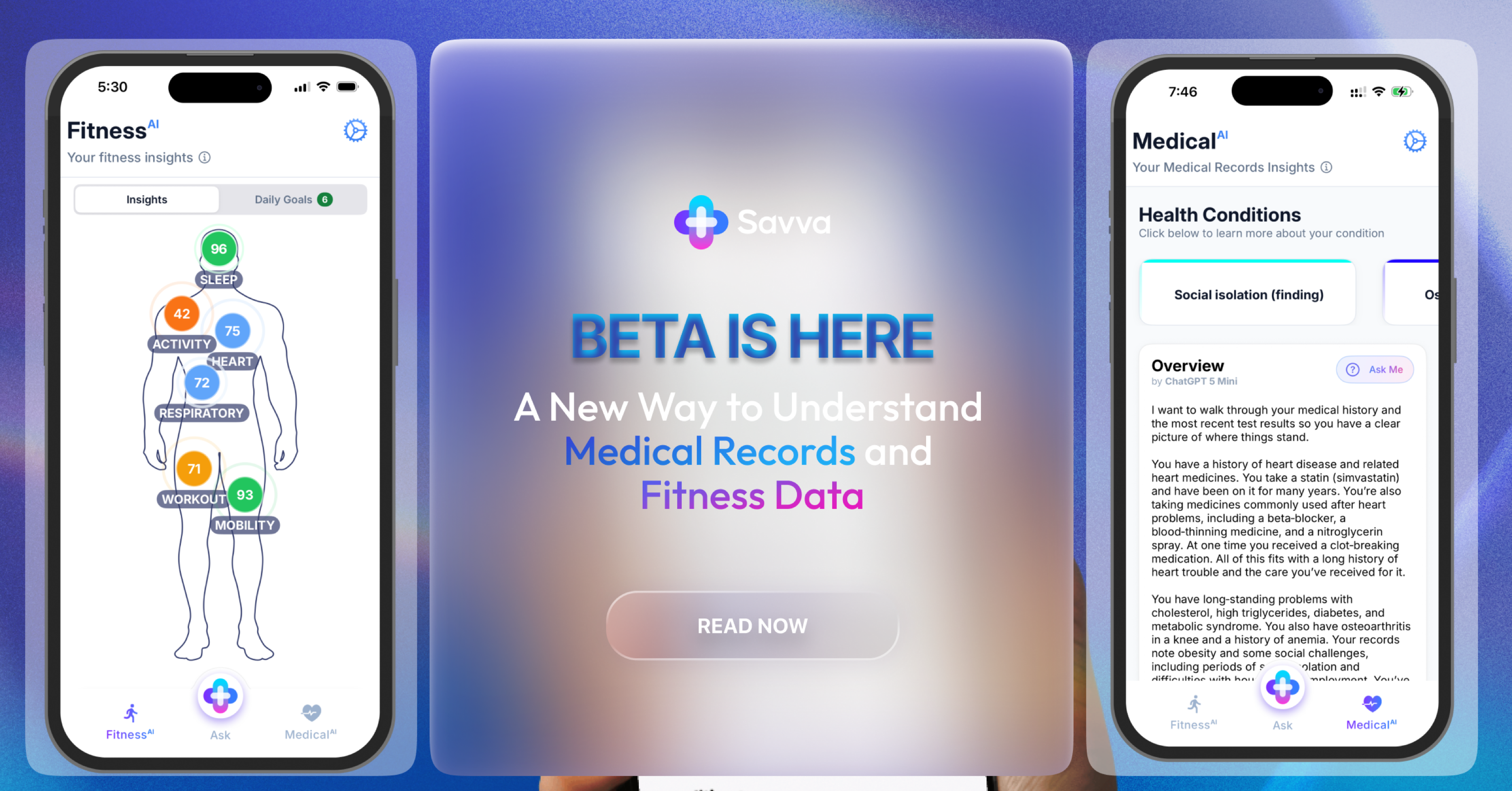
At Savva, we’re seeing a similar shift in health data tools. Even on older iPhones like the 12, Savva can process records and wearable data directly on device. Instead of sending heart rate, prescriptions, or blood pressure data to a server, the phone can organize that information locally. It’s faster, more private, and keeps more of the workflow on the device.
Enter the A19 Pro: When Intelligence Gets Personal
Fast-forward to the iPhone 17 Pro, and Apple’s new A19 Pro chip takes everything the A17 started and makes it faster and more capable. Apple’s new Neural Matrix Cluster doubles AI performance to 60 trillion operations per second while using less power. The CPU processes tasks faster, the neural cores run larger models offline, and your phone can handle more tasks without depending on the cloud.
It’s the same philosophy behind Apple’s M5 chip for Macs and iPads, keeping intelligence with the user instead of sending every task away to a server. With the A19 Pro, tasks that once required huge infrastructure can now happen instantly, like editing 4K video, generating summaries, or running Siri’s AI offline.
And this kind of intelligence is exactly what makes apps like Savva possible. Savva uses on-device AI capability to take fitness tracker readings, medical records, and health history and turn them into simpler, more readable summaries.
No waiting for a cloud server to process your information. It can run quietly in the background, even in airplane mode, tracking your data throughout the day and giving you a daily summary you can review at a glance.
M5 and A19 Pro: The Same Vision at Different Scales
The M5, designed for Macs and iPads, handles heavy creative and technical workloads, AI training, rendering, and multitasking, all within a unified CPU-GPU-Neural structure. It’s built for professionals who once depended on remote compute power.
The A19 Pro condenses that same philosophy into a phone. Together, they mark Apple’s full shift toward what we might call “The Great Deflation,” a world where we don’t rent intelligence from the cloud anymore; we carry more of it with us.
For health data, that shift is meaningful. Savva follows the same principle, giving users more control over their records, medical summaries, and fitness insights while keeping the workflow private, organized, and fast.
When Your Devices Start Working Together
This shift isn’t happening in isolation. It’s also bringing in a new wave of connected intelligence where devices can share context and make the experience feel more continuous.
That idea is already starting to take shape across Apple’s ecosystem.
Imagine this: your iPhone reviews your sleep trends overnight. Your watch adds heart rate data. Your iPad gives you a daily summary you can review in one place. Savva is built on the same idea, a seamless network that brings together your health records and device data. It connects data from Oura, Apple Health, Whoop, Fitbit, and others so you can review medical summaries and fitness insights without sending everything away for processing.
It might sound futuristic, but it’s already happening, powered by the same chips driving today’s mobile AI revolution.
Privacy Is the New Trust
This new era of on-device intelligence quietly fixes one of technology’s biggest problems: trust. When your data stays on your device, there’s less risk of it being exposed or reused in ways you did not expect. It’s privacy by design, not an add-on.
That’s exactly the approach we take at Savva. We don’t need to pull all of your data into external servers just to organize it. Instead, we keep your medical summaries and fitness insights on your phone, under your control.
At the end of the day, people don’t just want AI to be smart, they want it to feel trustworthy.
Conclusion: The Personal Revolution Has Already Started
If you zoom out, the story here isn’t just about Apple’s chips or Savva’s AI. It’s about the direction the entire industry is heading. We’ve gone from mainframes to PCs, from PCs to the cloud, and now from the cloud back to our pockets. Each step has brought intelligence closer to us, smaller, faster, and more personal.
With Apple’s A19 Pro pushing AI into the hands of everyday users, and Savva putting that power to work in health data organization, we’re watching the next big shift unfold not in the cloud, but right where it matters most: on the device in your hand.
That’s the real “Great Deflation.” Not just in economics, but in distance. The space between people and their technology is collapsing, and that’s where a more personal version of AI is starting to take shape.